- Main page
- Information Center
- Government News
Government News
Visit korean.net to see a variety of policies and relevant news of the Korean government.
Nation's first satellite for agriculture, forestry enters orbit
- Source
- korea.net
- Date
- 2026.07.10
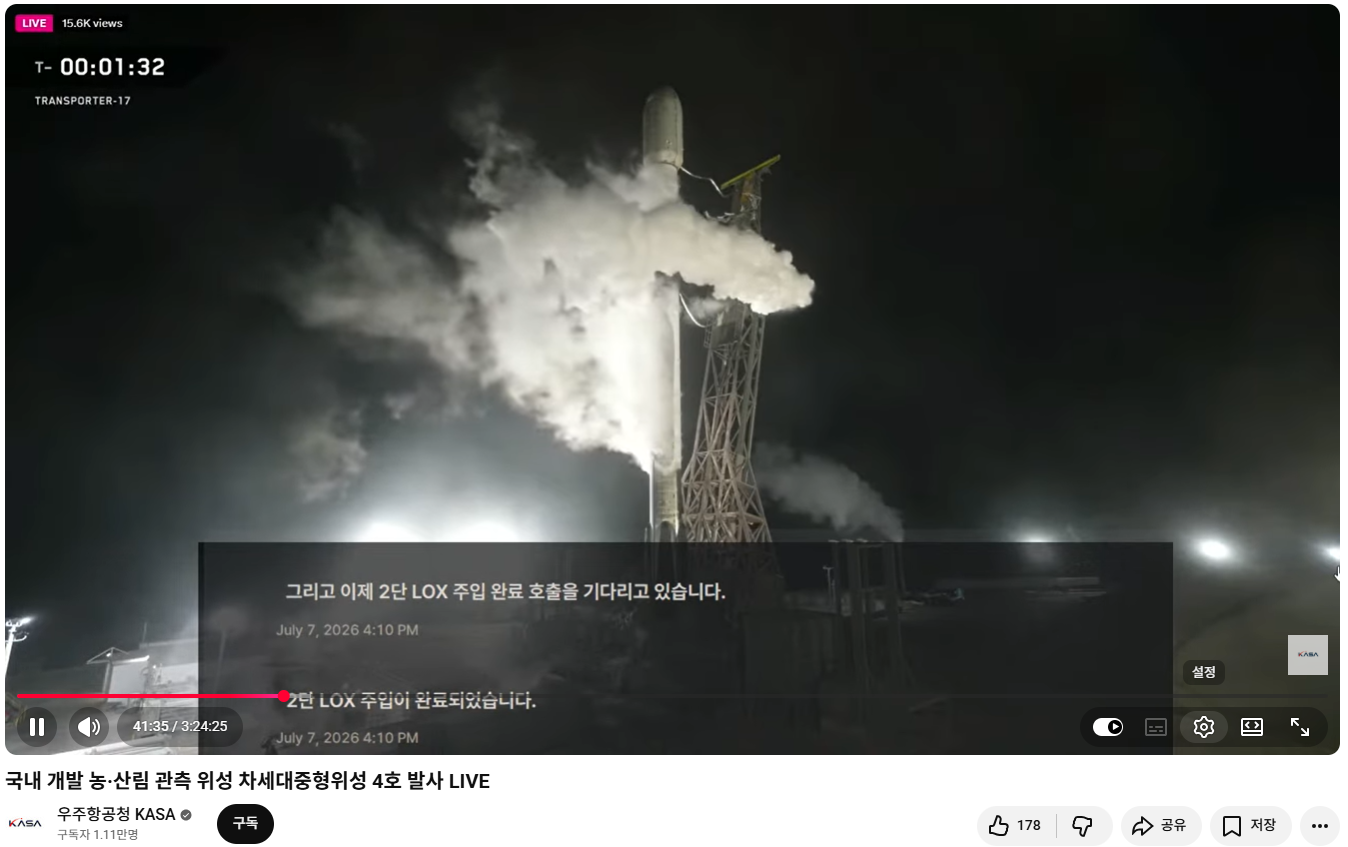
A SpaceX Falcon 9 rocket carrying the CAS500-4, a next-generation mid-size satellite exclusively for observation of agriculture and forestry, on July 7 stands on the launch pad ahead of its scheduled takeoff at 4:10 p.m. at Vandenberg Space Force Base in California. (Screenshot from Korea AeroSpace Administration's official YouTube channel)
By Uyen Nguyen
A next-generation mid-sized homegrown satellite for the exclusive observation of agriculture and forestry has entered orbit.
The Korea AeroSpace Administration, Rural Development Administration and Korea Forest Service said the CAS500-4 (Compact Advanced Satellite 500) was launched on July 7 at 4:10 p.m. (Korean Standard Time) from Vandenberg Space Force Base in California. It established its first communication with the Korea Aerospace Research Institute's (KARI) ground station in Daejeon at 10:50 p.m. the same day.
The satellite separated from the launch vehicle about 2 hours and 22 minutes after takeoff and made its first contact with a ground station in Svalbard, Norway. It later communicated with three other stations abroad including King Sejong Station in Antarctica before doing so with a domestic ground station.
In its first communication in Korea, KARI confirmed the deployment of solar panels and the condition of the satellite's main body. It plans to sequentially deploy the X-band antenna, activate actuators of the attitude control system and perform functional inspections.
CAS500-4 has a wide-area observation camera developed with domestic technology that captures images of the Korean Peninsula every three days. This provides data for agriculture and forest management, monitoring changes in forest cover, responding to disasters like wildfires, analyzing climate change and upholding public safety.
Following an initial operational phase of four months, the satellite will begin full-fledged observation of agriculture and forestry next year.
uyen81@korea.kr